

UPSC NDA 2 2026 Written Exam Analysis: Difficulty, Paper Pattern, Safe Score & Key Insights
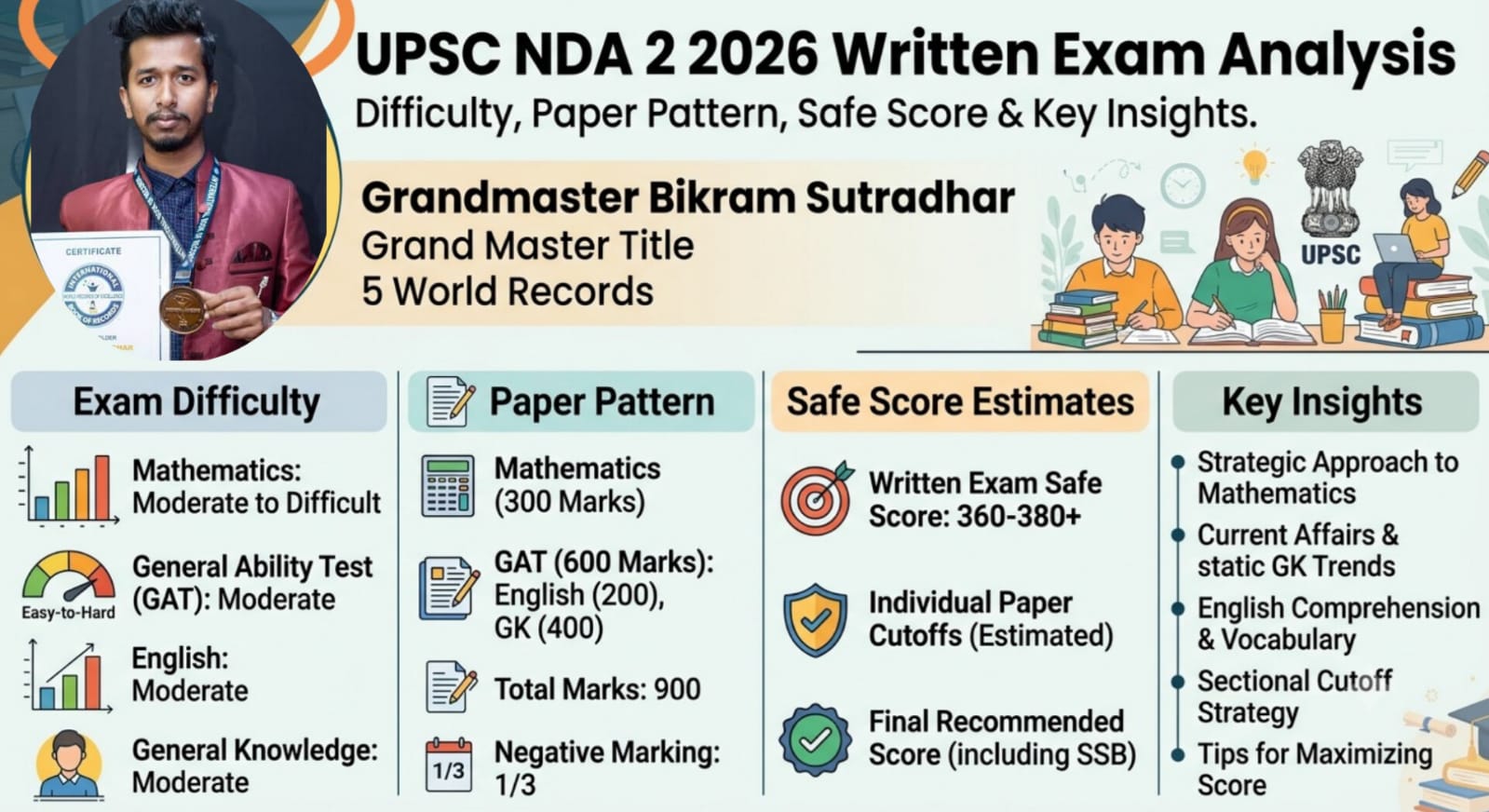
UPSC NDA 2 2026 Written Exam Analysis: Difficulty, Paper Pattern, Safe Score & Key Insights
UPSC NDA 2 2026 Written Exam Analysis: Difficulty, Paper Pattern, Safe Score & Key Insights
A detailed and student-focused analysis of the UPSC NDA 2 2026 written examination, covering Mathematics, General Ability Test, difficulty trends, scoring strategy, sectional qualifying requirements and the road ahead for aspirants.
Every competitive examination is more than a test of knowledge. It is a test of discipline, patience, decision-making and mental balance. The spirit of preparation is beautifully reflected in the timeless idea of performing one’s duty with sincerity while remaining focused on the process.
“Focus on your duty, strengthen your mind, and let your effort become your identity.”
UPSC NDA 2 2026 at a Glance
UPSC NDA 2 2026 Exam Blueprint
📐 Paper I — Mathematics
Time: 10:00 AM – 12:30 PM
Questions: 120 MCQs
Maximum Marks: 300
Negative Marking: One-third of the marks assigned to the question.
The Mathematics paper demanded a combination of conceptual understanding, calculation speed and careful question selection. Candidates who attempted questions without sufficient verification risked losing marks through negative marking.
🌍 Paper II — General Ability Test
Time: 2:00 PM – 4:30 PM
Questions: 150 MCQs
Maximum Marks: 600
Negative Marking: One-third of the marks assigned to the question.
GAT tested English proficiency along with General Knowledge, Science, History, Geography, Polity and current-affairs awareness.
Paper I: Mathematics — Detailed Analysis
Mathematics was broadly perceived as a Moderate to Hard paper. The examination rewarded candidates who combined conceptual clarity with efficient time management.
| Difficulty Level | Approximate Questions | Assessment |
|---|---|---|
| Easy | 38 | Easy |
| Moderate | 52 | Moderate |
| Difficult | 30 | Difficult |
Major Mathematical Areas
Paper II: General Ability Test — Detailed Analysis
The GAT paper offered a broad test of language ability, scientific awareness, social sciences and current events. Overall, it can be viewed as a Moderate paper with significant variation between sections.
| Section | Questions | General Assessment |
|---|---|---|
| English | 50 | Easy–Moderate |
| Physics | — | Conceptual |
| Chemistry & Biology | — | NCERT-Oriented |
| History | — | Moderate |
| Geography | — | Conceptual |
| Polity | — | Relatively Easier |
| Current Affairs | — | Challenging |
English — The Scoring Opportunity
English remained an important scoring component. Grammar, vocabulary, sentence correction, sequencing, voice and narration formed the core of the language-oriented preparation required for the examination.
Science — Concept Over Memorisation
Physics required candidates to understand concepts instead of depending entirely on memorised facts. Chemistry and Biology remained closely connected with school-level fundamentals and NCERT-oriented preparation.
Current Affairs — A Test of Awareness
Current affairs required candidates to connect national and international developments with defence, government, science and broader national issues. Statement-based questions could create difficulty for candidates who relied only on one-line factual revision.
⏳ Your Next Mission Starts Now
Sectional Qualifying Requirement
NDA written examination candidates must pay attention not only to their overall score but also to the prescribed qualifying requirement in each paper.
*Qualifying standards and final cut-offs are determined by the competent authority. Candidates should always verify the official UPSC notification and result notice for the applicable cycle.
Expected Score Zones — A Practical View
A score in this region would represent a highly competitive written performance based on the projected benchmark discussed in this analysis. Candidates should continue preparing seriously for the next stage.
This range can place an aspirant in a strong competitive position, although actual selection depends on the official cut-off and subsequent stages.
Candidates in this range should avoid making assumptions before the official cut-off is released. Accuracy, category and other applicable factors matter.
Aspirants should wait for the official result rather than relying on unofficial predictions. At the same time, beginning preparation for the next examination cycle can be a productive strategy.
What NDA Aspirants Should Learn From This Paper
1. Accuracy Is More Valuable Than Random Attempts
Negative marking makes uncontrolled guessing dangerous. The goal should be to maximise correct answers rather than simply increase the number of attempts.
2. Build Conceptual Strength
Mathematics and Science increasingly reward candidates who understand why a formula or concept works instead of merely memorising it.
3. Practise Under Real Time Limits
Solving questions at home without a time constraint does not fully reproduce the pressure of a competitive examination. Regular timed mock tests are essential.
4. Revise NCERT Fundamentals
Strong school-level fundamentals remain extremely valuable for the GAT Science and Social Science sections.
5. Develop a Calm Examination Mind
A difficult question should not be allowed to consume several minutes. Skip strategically, return later and protect your mental rhythm.
Success does not arrive because every day is easy. It arrives because the aspirant continues working even when the result is uncertain.
Discipline creates consistency. Knowledge creates confidence. Patience creates stability. And self-belief gives the courage to continue.
Your examination is a moment. Your preparation is a journey. Build the journey with sincerity.
UPSC NDA 2 2026 Written Exam Analysis: Difficulty, Paper Pattern, Safe Score & Key Insights