
BASTRONAUTWAY CTET 2026 Mathematics Master Notes part 1
BASTRONAUTWAY CTET 2026 Mathematics Master Notes part 1
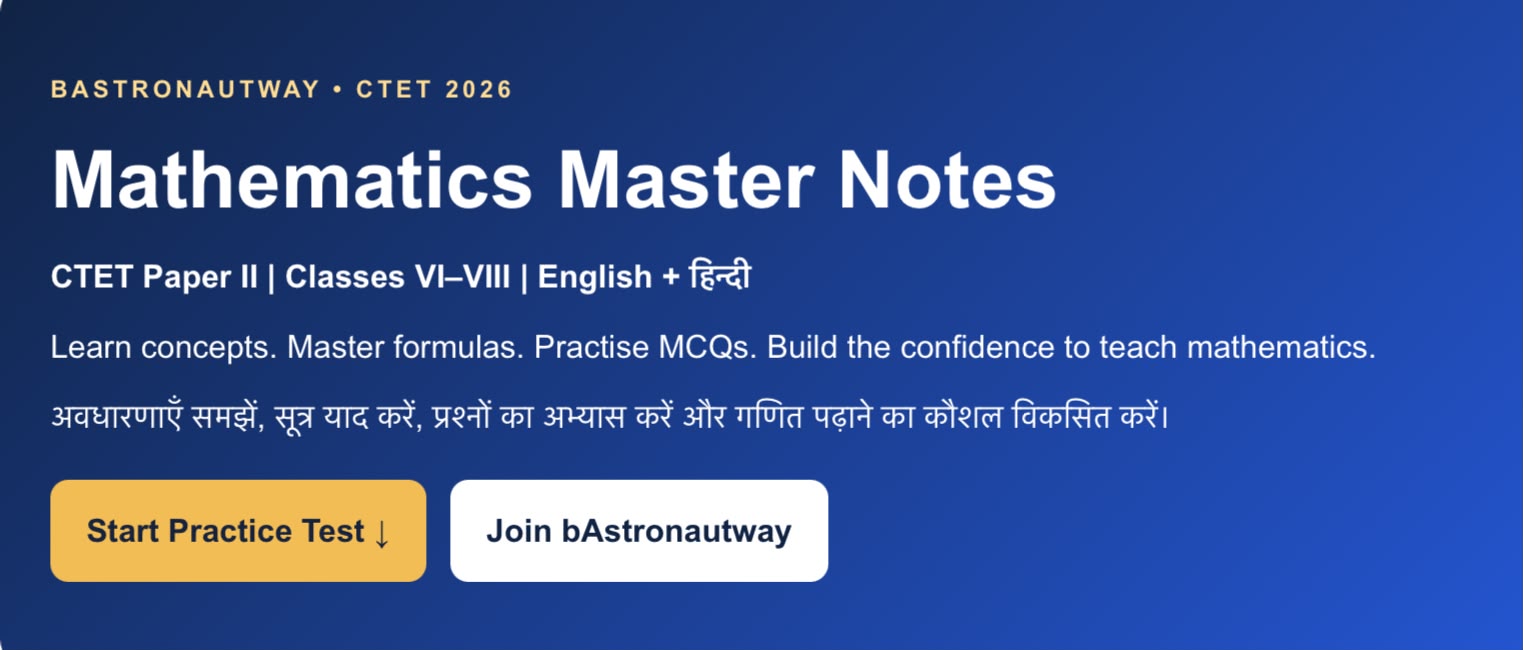
Mathematics Master Notes
CTET Paper II | Classes VI–VIII | English + हिन्दी
Learn concepts. Master formulas. Practise MCQs. Build the confidence to teach mathematics.
अवधारणाएँ समझें, सूत्र याद करें, प्रश्नों का अभ्यास करें और गणित पढ़ाने का कौशल विकसित करें।
Start Practice Test ↓ Join bAstronautwayHow to use these notes
Step 1: Read the English concept and Hindi explanation.
Step 2: Write the formulas in a notebook and solve the worked example yourself.
Step 3: Attempt the MCQs without looking at the answers.
Step 4: Review your mistakes and practise explaining the concept as a teacher.
पहले अवधारणा समझें, फिर सूत्रों का अभ्यास करें, स्वयं प्रश्न हल करें और अंत में शिक्षक की तरह समझाने का प्रयास करें।
Syllabus note: CTET Paper II Mathematics & Science traditionally includes 30 Mathematics and Science questions together, including pedagogy. Verify the current official information bulletin for the applicable cycle and exact structure. These notes are a study aid, not a prediction of the exam paper.
01. Number System — संख्या पद्धति
A. Types of numbers / संख्याओं के प्रकार
Natural numbers: 1, 2, 3, … (counting numbers).
Whole numbers: 0, 1, 2, 3, …
Integers: …, −3, −2, −1, 0, 1, 2, 3, …
Rational numbers: Numbers expressible as p/q, where p and q are integers and q ≠ 0. उदाहरण: 3/4, −2, 0.5.
Fractions: Proper (numerator smaller than denominator), improper (numerator at least denominator), and mixed fractions.
परिमेय संख्याएँ: जिन्हें p/q के रूप में लिखा जा सकता है, जहाँ q शून्य नहीं है। पूर्णांक, भिन्न और समाप्त या आवर्ती दशमलव इसके उदाहरण हैं।
B. Rules and formulas / नियम और सूत्र
a/b + c/d = (ad + bc)/bd
a/b − c/d = (ad − bc)/bd
(a/b) × (c/d) = ac/bd
(a/b) ÷ (c/d) = ad/bc, where c ≠ 0
aᵐ × aⁿ = aᵐ⁺ⁿ
aᵐ ÷ aⁿ = aᵐ⁻ⁿ (a ≠ 0)
(aᵐ)ⁿ = aᵐⁿ
(ab)ⁿ = aⁿbⁿ
a⁰ = 1 (a ≠ 0); a⁻ⁿ = 1/aⁿ (a ≠ 0)
(+)(+) = +; (−)(−) = +; (+)(−) = −; (−)(+) = −.
For addition, subtract absolute values when signs differ and keep the sign of the number with the greater absolute value.
2: last digit even. 3: sum of digits divisible by 3. 4: last two digits divisible by 4. 5: ends in 0 or 5. 9: digit sum divisible by 9. 10: ends in 0.
C. Solved examples / हल किए गए प्रश्न
LCM of 4 and 3 = 12. So 9/12 + 8/12 = 17/12 = 1 5/12.
हल: हरों का LCM 12 है। इसलिए उत्तर 17/12 या 1 5/12 है।
9 − 8 = 1. Remember: (−3)² = 9, but −3² = −9 under standard order of operations.
ध्यान दें: कोष्ठक बदलने से उत्तर बदल सकता है।
Factors give HCF = 6. LCM = (12 × 18)/6 = 36.
02. Algebra — बीजगणित
A. Basics / मूल अवधारणाएँ
An algebraic expression contains variables, constants and operations. In 3x + 5, x is the variable, 3 is its coefficient and 5 is the constant.
बीजीय व्यंजक में चर, अचर और संक्रियाएँ होती हैं। समान पदों में चर और उनकी घातें समान होती हैं।
(a + b)² = a² + 2ab + b²
(a − b)² = a² − 2ab + b²
(a + b)(a − b) = a² − b²
a(b + c) = ab + ac
ax + b = c ⇒ x = (c − b)/a, where a ≠ 0
B. Equations and inequalities / समीकरण और असमिकाएँ
An equation has an equals sign. Keep both sides balanced by performing the same operation on both sides.
Example: 3x + 5 = 20 ⇒ 3x = 15 ⇒ x = 5.
For inequalities, adding or subtracting the same number preserves the sign. Multiplying or dividing by a negative number reverses it.
असमीकरण में दोनों पक्षों को ऋणात्मक संख्या से गुणा या भाग देने पर असमानता का चिह्न उलट जाता है।
C. Solved examples
4x = 20, therefore x = 5.
Combine like terms: 5a − 4.
Divide both sides by −2 and reverse the sign: x < −3.
03. Geometry — ज्यामिति
A. Lines and angles / रेखाएँ और कोण
Supplementary angles sum to 180°.
Angles on a straight line = 180°.
Angles around a point = 360°.
Vertically opposite angles are equal.
For parallel lines cut by a transversal: corresponding angles are equal; alternate interior angles are equal; co-interior angles sum to 180°.
B. Triangles / त्रिभुज
Exterior angle = sum of the two opposite interior angles.
Area = ½ × base × height.
For a right triangle: hypotenuse² = base² + perpendicular².
Congruence: Same shape and size; common tests include SSS, SAS, ASA and RHS for right triangles.
Similarity: Same shape, proportional corresponding sides, equal corresponding angles. Area ratio = square of the corresponding side ratio.
सर्वांगसम आकृतियों का आकार और माप समान होता है। समरूप आकृतियों का आकार समान होता है, लेकिन माप अलग हो सकता है।
C. Polygons and circles / बहुभुज और वृत्त
Each interior angle of a regular n-sided polygon = [(n − 2) × 180°]/n.
Sum of exterior angles of a convex polygon = 360°.
Circle circumference = 2πr = πd.
Circle area = πr²; diameter d = 2r.
Number of lines of symmetry of a regular polygon = n.
Quadrilaterals: Interior angles sum to 360°. A parallelogram has opposite sides parallel and equal; a rectangle has four right angles; a rhombus has four equal sides; a square has four equal sides and four right angles.
3D shapes: A cube has 6 faces, 12 edges and 8 vertices. A cuboid also has 6 faces, 12 edges and 8 vertices. A sphere has one curved surface and no edges or vertices.
D. Constructions / रचनाएँ
- Use a ruler to draw straight line segments and measure lengths.
- Use a protractor to measure or construct angles.
- Use a compass to draw circles, transfer lengths and construct perpendicular bisectors.
- Use ruler and compass to construct common angles and bisect angles, following the stated construction steps.
E. Solved examples
180° − (55° + 65°) = 60°.
Circumference = 2 × 22/7 × 7 = 44 cm.
Area = 22/7 × 7² = 154 cm².
(6 − 2) × 180° = 720°.
04. Mensuration — क्षेत्रमिति
A. 2D shapes / समतल आकृतियाँ
Rectangle (आयत): Perimeter = 2(l + b); area = lb.
Triangle (त्रिभुज): Area = ½bh.
Equilateral triangle: Area = (√3/4)a²; perimeter = 3a.
Parallelogram: Area = base × perpendicular height.
Rhombus: Area = ½d₁d₂.
Trapezium: Area = ½(a + b)h, where a and b are parallel sides.
Circle: Circumference = 2πr; area = πr².
B. Surface area and volume / पृष्ठीय क्षेत्रफल और आयतन
Cuboid: LSA = 2h(l + b); TSA = 2(lb + bh + hl); volume = lbh.
Cylinder: Curved surface area = 2πrh; TSA = 2πr(h + r); volume = πr²h.
Cone: Slant height ℓ = √(r² + h²); CSA = πrℓ; TSA = πr(ℓ + r); volume = ⅓πr²h.
Sphere: Surface area = 4πr²; volume = ⁴⁄₃πr³.
Hemisphere: Curved area = 2πr²; total area = 3πr²; volume = ⅔πr³.
Units: Perimeter is in units (cm, m); area in square units (cm², m²); volume in cubic units (cm³, m³). Convert units before calculating.
परिमाप लंबाई की इकाई में, क्षेत्रफल वर्ग इकाई में और आयतन घन इकाई में लिखा जाता है।
C. Solved examples
Area = 12 × 5 = 60 cm².
Perimeter = 2(12 + 5) = 34 cm.
V = a³ = 4³ = 64 cm³.
V = πr²h = π × 9 × 7 = 63π cm³ ≈ 197.92 cm³.
05. Ratio and Proportion — अनुपात और समानुपात
A. Key concepts / मुख्य अवधारणाएँ
A ratio compares quantities in the same units. Simplify a ratio by dividing both terms by their HCF.
अनुपात समान इकाइयों वाली राशियों की तुलना करता है। समानुपात में दो अनुपात बराबर होते हैं।
Proportion: a:b = c:d ⇒ ad = bc.
Direct proportion: y = kx; x₁/y₁ = x₂/y₂ for corresponding pairs in a direct proportion.
Inverse proportion: xy = k; x₁y₁ = x₂y₂ for corresponding pairs in an inverse proportion.
If a quantity is divided in ratio m:n, shares are [m/(m+n)] × total and [n/(m+n)] × total.
Percentage = (part/whole) × 100%.
Percentage change = (change/original value) × 100%.
B. Solved examples
Total parts = 5. First share = 600 × 2/5 = ₹240. Second share = 600 × 3/5 = ₹360.
Answer: ₹240 and ₹360.
Cost per notebook = 80/4 = ₹20. Total = 7 × 20 = ₹140.
Workers × days = constant. 6 × 10 = 12 × d ⇒ d = 5 days.
06. Data Handling — आँकड़ों का प्रबंधन
A. Statistics / सांख्यिकी
Median (माध्यिका): Middle observation after arranging data. For an even number of observations, average the two middle values.
Mode (बहुलक): Most frequent value.
Range (परास): Maximum value − minimum value.
Experimental probability: Number of times an event occurs ÷ total trials.
Theoretical probability: Favourable outcomes ÷ total equally likely outcomes.
B. Graphs and tables / आलेख और तालिकाएँ
- Bar graph: Compare categories using bars; check the scale and axis labels.
- Line graph: Show changes or trends, often over time.
- Pie chart: Represents parts of a whole; the full circle is 360°.
- Frequency table: Records how often each value or category appears.
Category value = (sector angle ÷ 360°) × total value.
Percentage of total = (category value ÷ total) × 100%.
C. Solved examples
Mean = 20/5 = 4. Median = 3. Mode = 3. Range = 7 − 2 = 5.
Angle = 30/120 × 360° = 90°.
Favourable outcomes = 2, 4, 6: three outcomes out of six. Probability = 3/6 = 1/2.
Bonus: Mathematics Pedagogy
Child-centred learning: Begin with students’ existing knowledge and everyday experiences.
Concrete → Pictorial → Abstract: Use real objects, drawings and then symbols or formulas.
Activity-based teaching: Let learners explore patterns, estimate, measure, discuss and solve problems.
Assessment for learning: Use diagnostic questions, observation, class discussion and feedback to identify misconceptions.
Common misconceptions: Larger denominator does not always mean a larger fraction; area and perimeter are different; multiplying always increases a number only under certain conditions.
गणित शिक्षण में गतिविधियों, वास्तविक जीवन के उदाहरणों, चर्चा और बच्चों की गलतियों के विश्लेषण का उपयोग करें। केवल सूत्र रटवाने के बजाय अवधारणा विकसित करें।
CTET Mathematics Practice Test
12 topic-wise questions • Choose one answer per question. Answers and explanations appear after selection.
हर प्रश्न का एक उत्तर चुनें। सही उत्तर और उसका कारण तुरंत देखें।
Attempt the questions to review your progress.
https://www.youtube.com/@SirBikramSutradhar