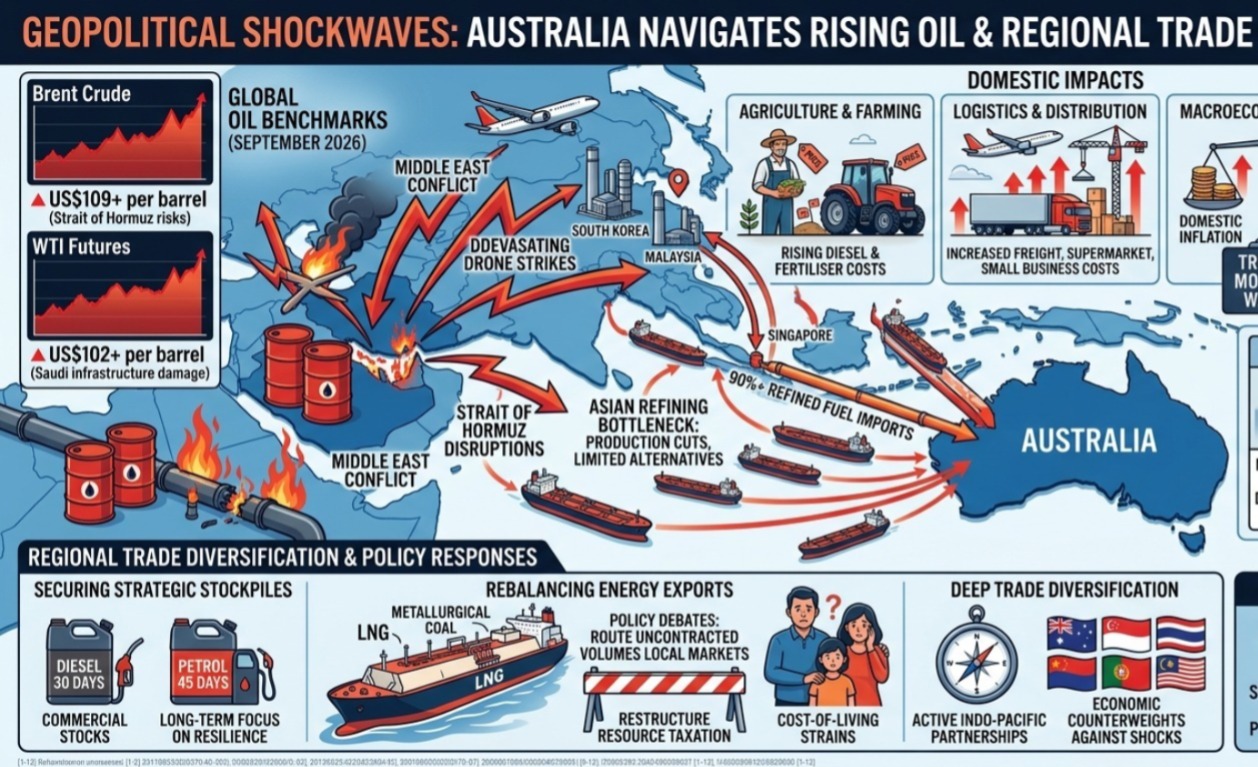

Geopolitical Shockwaves: How Australia Is Navigating Oil Volatility and Trade Strains
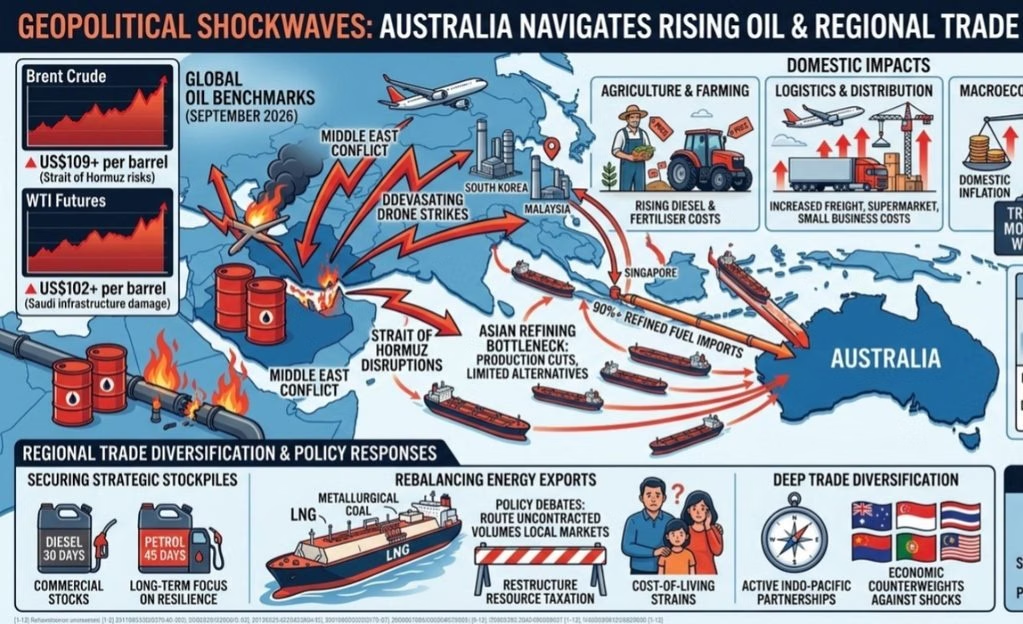
Geopolitical Shockwaves: How Australia Is Navigating Oil Volatility and Trade Strains
Geopolitical Shockwaves: How Australia Is Navigating Oil Volatility and Trade Strains
Why international energy disruptions matter for Australia’s fuel security, transport system, businesses, households and economic resilience.
1. Why International Oil Volatility Matters
Oil is deeply connected to modern economic activity. It supports transportation, logistics, manufacturing, agriculture, aviation and many other activities that depend on liquid fuels.
As a result, changes in international petroleum markets can have effects beyond fuel stations. The eventual impact depends on the size and duration of a disruption, the availability of alternative supplies and the ability of businesses and consumers to adjust.
2. How an External Energy Shock Can Reach Australia
International energy disruptions can pass through several stages before their effects become visible in the domestic economy.
3. Australia’s Petroleum Import Exposure
Australian Government energy statistics show that refined petroleum products and crude oil are the country’s largest energy-import categories. In 2023–24, refined products accounted for the largest share of energy imports, while crude oil and refinery feedstock were another major category.
The same official data shows that 79% of refined petroleum-product consumption was met through imports in 2023–24. This was the highest level recorded in that dataset.
| Indicator | 2023–24 | What It Shows |
|---|---|---|
| Energy exports | 15,292 PJ | Australia remains a major energy-exporting economy. |
| Energy imports | 2,320 PJ | Australia also relies on imported energy. |
| Refined-product import share | 79% | Imported refined products met a substantial share of domestic consumption. |
| Largest import categories | Refined products + crude/feedstock | Petroleum products dominate Australia’s energy imports. |
4. The Australian Energy Paradox
Australia demonstrates why energy security is more complicated than simply measuring how much energy a country produces.
🌏 Strong Export Position
Australia exports large quantities of energy commodities to international markets.
⛽ Petroleum Dependence
Refined petroleum products remain an important component of Australia’s imported energy supply.
🚢 Global Supply Chains
International shipping, refining capacity and supplier reliability can therefore influence domestic fuel security.
🛡️ Resilience Matters
Strong inventories, reliable infrastructure and diversified supply arrangements can improve the ability to manage disruption.
5. From Fuel Costs to Household Budgets
Fuel does not affect households only through the price displayed at a petrol station. Transportation is embedded in the movement of products across the economy.
🚚 Freight
Road freight uses fuel to move food, manufactured products and other goods between producers, warehouses and consumers.
🌾 Agriculture
Farming activities can be exposed to fuel and transport costs through machinery, logistics and other energy-intensive inputs.
✈️ Aviation
Air transport depends heavily on liquid fuels, linking global energy conditions with aviation operating costs.
🏭 Business
Companies can face higher operating costs when transportation and energy expenses remain elevated.
6. Why Fuel Security Requires More Than Domestic Production
Domestic energy production is an important economic strength, but petroleum security also depends on refining, storage, transportation, imports and infrastructure.
The Australian Government’s petroleum statistics program tracks petroleum sales, stocks, imports, exports, crude production and refinery activity. These measurements help provide a picture of Australia’s fuel-supply system.
7. What Can Strengthen Australia’s Energy Resilience?
| Approach | Potential Role |
|---|---|
| Supplier diversification | Reduces dependence on a narrow group of external sources. |
| Strategic inventories | Provide additional flexibility during temporary disruptions. |
| Infrastructure investment | Strengthens storage, distribution and supply-chain resilience. |
| Energy efficiency | Can reduce exposure to fuel-price movements over time. |
| Alternative technologies | Can gradually reduce petroleum dependence in suitable sectors. |
8. The Inflation Connection
Energy costs can influence inflation through both direct and indirect channels. Petrol and diesel prices can affect household transportation expenses, while fuel-dependent businesses can face higher operating costs.
Direct pressure
Changes in fuel prices can directly influence transportation expenses for households and businesses.
Indirect pressure
Higher transport and operating costs can affect the prices of products and services.
9. Four Possible Paths Ahead
If international supply conditions become more predictable, pressure on energy markets could moderate.
Continued uncertainty could keep attention focused on fuel costs, household budgets and business expenses.
A significant interruption to international petroleum flows could create stronger supply and price pressures.
Greater diversification, efficiency and infrastructure investment could gradually reduce vulnerability to individual disruptions.
Final Analysis
Australia’s energy position is stronger and more complex than a simple producer-versus-importer label suggests.
Official Australian Government statistics show that the country is a substantial energy exporter while also relying heavily on imported petroleum products. That combination makes international energy conditions relevant to Australia’s domestic economy even when domestic energy production remains strong.
The long-term challenge is therefore resilience: maintaining reliable supply chains, adequate stocks, diversified sources, efficient infrastructure and a flexible energy system capable of responding to unexpected global disruptions.
📚 Sources & Data
This article is independently written editorial analysis. Statistical information has been limited to publicly available Australian Government energy data and is presented in original wording.
Primary data source: Australian Government — Australian Energy Statistics.
Australian Energy StatisticsPetroleum data: Australian Government — Australian Petroleum Statistics.
Australian Petroleum StatisticsEnergy trade data: Australian Government — Australian energy trade 2023–24.
Australian Energy Trade 2023–24Geopolitical Shockwaves: How Australia Is Navigating Oil Volatility and Trade Strains