
Vedic Mathematics: Learn 16 Sutras, Easy Tricks and Mental Maths
Vedic Mathematics: Learn 16 Sutras, Easy Tricks and Mental Maths
Vedic Mathematics: Learn 16 Sutras, Easy Tricks and Mental Maths
Discover simple calculation techniques, multiplication shortcuts, squaring methods, division strategies and practical mathematics exercises for students and beginners.
1. What Is Vedic Mathematics?
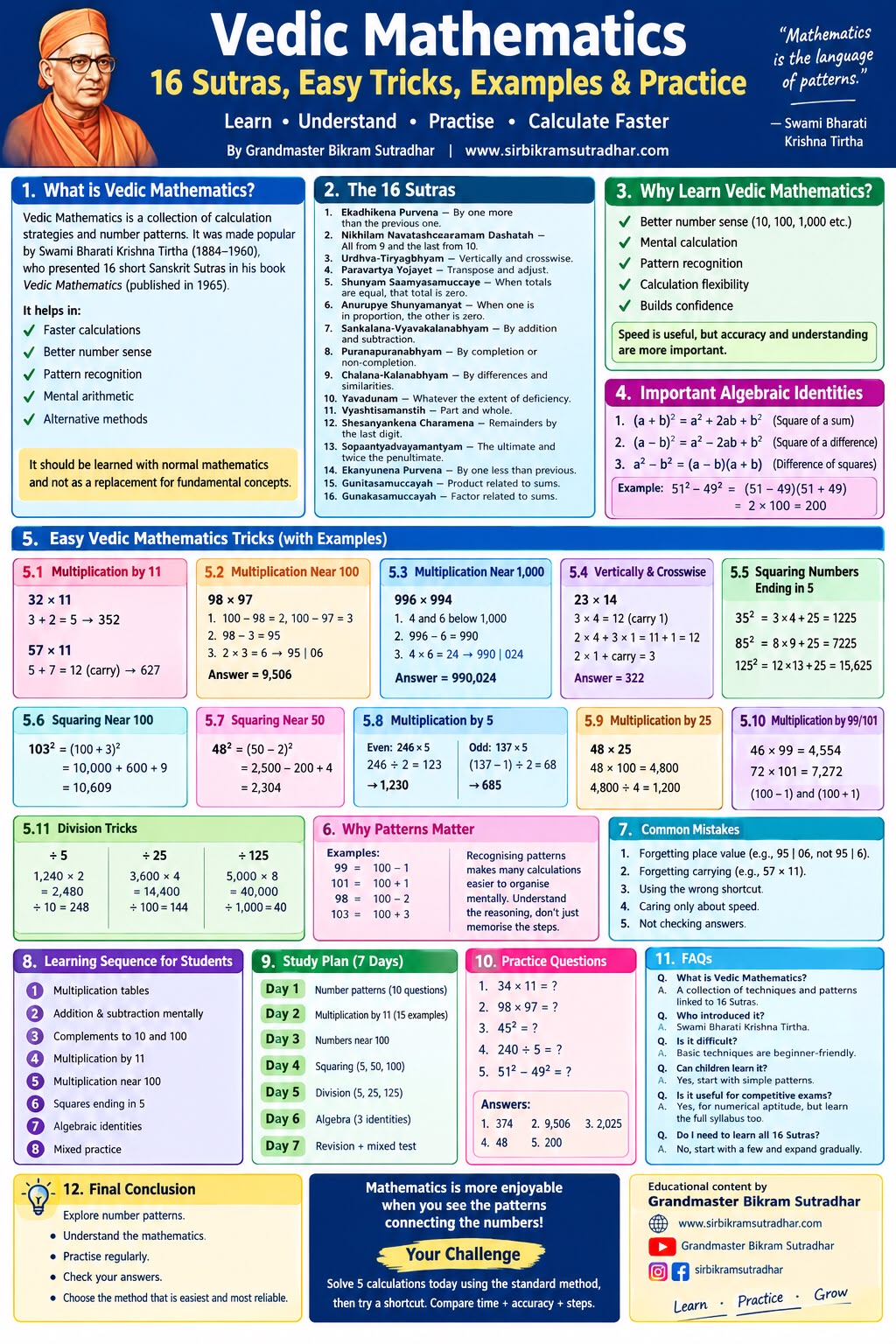
Vedic Mathematics is the name commonly given to a collection of mathematical techniques popularised by Swami Bharati Krishna Tirtha in the twentieth century. Many of these techniques use number patterns, complements, mental calculation and algebraic relationships to make selected calculations easier.
The methods can help learners explore arithmetic in different ways. Instead of relying on only one written procedure, students can learn to recognise patterns and choose a method that suits the problem.
Understand Patterns
Learn how numbers relate to one another.
Calculate Mentally
Practise useful mental arithmetic shortcuts.
Improve Accuracy
Check answers using alternative methods.
Build Confidence
Progress from simple examples to harder problems.
2. History and Background
Swami Bharati Krishna Tirtha lived from 1884 to 1960. He presented a system of mathematical techniques organised around short Sanskrit statements known as sutras. His book Vedic Mathematics was published in 1965, five years after his death.
The system became known for methods involving multiplication, complements, algebraic manipulation and mental calculation. Teachers subsequently developed lessons and exercises to help students practise these approaches.
The claimed ancient Vedic origins of the complete system remain a matter of historical discussion. Readers should distinguish the modern collection of techniques from independently documented achievements in the history of Indian mathematics.
Why is it popular today?
- Some methods are easy to demonstrate visually.
- Number patterns make arithmetic more engaging.
- Selected calculations can be completed with fewer written steps.
- Students can compare different approaches to the same problem.
- Short exercises are suitable for daily practice.
3. Benefits of Learning Vedic Mathematics
Better number sense
Complement methods encourage students to understand the distance between a number and a convenient base such as 10, 100 or 1,000.
Flexible calculation strategies
A student may use ordinary multiplication, a distributive expansion or a suitable shortcut. Comparing methods builds flexibility.
Useful examination practice
Mental arithmetic techniques may help with selected numerical aptitude questions. Students must still practise the actual examination syllabus and time limits.
More confidence with numbers
Starting with manageable examples and checking each answer helps learners become more comfortable with calculations.
Results depend on the learner, the method and the amount of practice. No shortcut guarantees perfect accuracy or success in every examination.
4. The 16 Sutras of Vedic Mathematics
The following are commonly listed English renderings of the sixteen sutras associated with the modern Vedic Mathematics system. Translations and interpretations can vary. The explanations below describe common teaching applications rather than claiming that every sutra has only one mathematical meaning.
| No. | Sutra | Common English Rendering | Learning Idea |
|---|---|---|---|
| 1 | Ekadhikena Purvena | By one more than the previous one | Useful in certain multiplication and squaring patterns. |
| 2 | Nikhilam Navatashcaramam Dashatah | All from 9 and the last from 10 | Complements and numbers close to a base. |
| 3 | Urdhva-Tiryagbhyam | Vertically and crosswise | A structured multiplication method. |
| 4 | Paravartya Yojayet | Transpose and adjust | A principle used in selected division and algebra methods. |
| 5 | Shunyam Saamyasamuccaye | When the relevant totals are equal, that total is zero | A specialised algebraic principle; context matters. |
| 6 | Anurupye Shunyamanyat | When one is in proportion, the other is zero | Specialised proportional relationships. |
| 7 | Sankalana-Vyavakalanabhyam | By addition and subtraction | Combining equations and simplifying expressions. |
| 8 | Puranapuranabhyam | By completion or non-completion | Completing a convenient number or expression. |
| 9 | Chalana-Kalanabhyam | By differences and similarities | Comparing expressions and related quantities. |
| 10 | Yavadunam | Whatever the extent of the deficiency | Numbers close to a convenient base. |
| 11 | Vyashtisamanstih | Part and whole | Breaking a problem into parts and recombining them. |
| 12 | Shesanyankena Charamena | The remainders by the last digit | Selected remainder and divisibility techniques. |
| 13 | Sopaantyadvayamantyam | The ultimate and twice the penultimate | A specialised rule used in particular calculations. |
| 14 | Ekanyunena Purvena | By one less than the previous one | Selected multiplication patterns. |
| 15 | Gunitasamuccayah | A product-related relationship involving sums | Checking certain algebraic identities. |
| 16 | Gunakasamuccayah | A factor-related relationship involving sums | Selected factorisation and algebraic checks. |
5. Easy Vedic Mathematics Techniques
Lesson 1: Multiply a number by 11
For a two-digit number, add its two digits and place the sum between the digits. If the sum is 10 or more, carry the extra value to the left.
Example: 32 × 11
Step 1: The digits are 3 and 2.
Step 2: Add them: 3 + 2 = 5.
Step 3: Put 5 between 3 and 2.
Example: 57 × 11
5 + 7 = 12.
Write 2 in the middle and carry 1 to the left.
Check: 57 × 11 = 57 × (10 + 1) = 570 + 57 = 627.
Lesson 2: Multiply numbers near 100
This method uses the Nikhilam complement idea. It works particularly neatly when both numbers are close to 100.
Example: 98 × 97
Step 1: Find the deficiencies from 100.
98 is 2 below 100; 97 is 3 below 100.
Step 2: Subtract crosswise.
98 − 3 = 95.
Step 3: Multiply the deficiencies.
2 × 3 = 6. Since the base is 100, write this as 06.
Answer: 9,506
Lesson 3: Multiply numbers near 1,000
Example: 996 × 994
996 is 4 below 1,000.
994 is 6 below 1,000.
Cross-subtract: 996 − 6 = 990.
Multiply deficiencies: 4 × 6 = 24.
Because the base is 1,000, the right-hand part must contain three digits: 024.
Answer: 990,024
Lesson 4: Vertically and crosswise multiplication
The Urdhva-Tiryagbhyam approach is a structured way to combine partial products. For two-digit numbers, it can be demonstrated in three stages.
Example: 23 × 14
Step 1 — Units: 3 × 4 = 12.
Write 2 and carry 1.
Step 2 — Crosswise: 2 × 4 + 3 × 1 = 11.
Add the carry: 11 + 1 = 12.
Write 2 and carry 1.
Step 3 — Tens: 2 × 1 + 1 = 3.
The same result follows from ordinary multiplication: 23 × 14 = 23 × (10 + 4) = 230 + 92 = 322.
Lesson 5: Square numbers ending in 5
A useful pattern allows numbers ending in 5 to be squared mentally.
Example: 35²
Step 1: Take the first digit, 3.
Step 2: Multiply it by the next integer: 3 × 4 = 12.
Step 3: Append 25.
Example: 85²
8 × 9 = 72.
Append 25.
Why does it work? If a number is 10a + 5, its square is 100a(a + 1) + 25. The pattern follows directly from algebra.
Lesson 6: Square a number near 100
Example: 103²
103 = 100 + 3.
Use (a + b)² = a² + 2ab + b².
103² = 100² + 2 × 100 × 3 + 3².
= 10,000 + 600 + 9.
Lesson 7: Multiply by 5
For an even whole number, divide by 2 and append a zero. For an odd whole number, subtract 1, divide by 2 and append 5.
Example: 246 × 5
246 ÷ 2 = 123.
Example: 137 × 5
137 − 1 = 136.
136 ÷ 2 = 68.
6. Multiplication Shortcuts
Distributive multiplication
Break one number into convenient parts. This is an ordinary mathematical property that also supports many mental arithmetic techniques.
Example: 48 × 25
25 = 100 ÷ 4.
48 × 25 = 48 × 100 ÷ 4.
= 4,800 ÷ 4.
Multiply 99 by a number
Example: 46 × 99
99 = 100 − 1.
46 × 99 = 46 × 100 − 46.
= 4,600 − 46.
Multiply 101 by a number
Example: 72 × 101
101 = 100 + 1.
72 × 101 = 7,200 + 72.
7. Squaring Numbers: More Examples
Square a number ending in 5
Square numbers near 50
Example: 48²
48 = 50 − 2.
48² = 50² − 2 × 50 × 2 + 2².
= 2,500 − 200 + 4.
Square numbers near 1,000
Example: 1,002²
1,002 = 1,000 + 2.
1,002² = 1,000,000 + 4,000 + 4.
These examples are applications of algebraic identities. Understanding why the identities work is more valuable than memorising answers.
8. Division Techniques
Division shortcuts can be useful when the divisor has a convenient relationship with a base. The following examples demonstrate simple ways to reorganise a calculation.
Divide by 5
Example: 1,240 ÷ 5
Dividing by 5 is equivalent to multiplying by 2 and dividing by 10.
1,240 × 2 = 2,480.
2,480 ÷ 10 = 248.
Divide by 25
Example: 3,600 ÷ 25
25 × 4 = 100.
Multiply the dividend by 4, then divide by 100.
3,600 × 4 = 14,400.
14,400 ÷ 100 = 144.
Divide by 125
Example: 5,000 ÷ 125
125 × 8 = 1,000.
5,000 × 8 = 40,000.
40,000 ÷ 1,000 = 40.
9. Algebra and Number Patterns
Vedic Mathematics lessons also encourage students to explore algebraic relationships. The following identities are fundamental mathematical tools that explain several shortcuts.
Identity 1: Square of a sum
Example:
Identity 2: Square of a difference
Example:
Identity 3: Difference of two squares
Example:
Identity 4: Multiplication by decomposition
Example:
These identities are part of standard algebra. They are especially useful when a number can be split into convenient components.
10. Interactive Mathematics Calculator
Enter two numbers and select an operation. Use this tool to check the answers to your own practice questions.
This is a basic arithmetic calculator, not a proof that every calculation uses a Vedic Mathematics technique.
11. Vedic Mathematics Practice Quiz
Answer all five questions. Select your answers and click Check My Score.
Questions answered: 0 of 5
12. Seven-Day Vedic Mathematics Learning Plan
| Day | Topic | Daily Practice |
|---|---|---|
| Day 1 | Number patterns and complements | Practise 10 calculations involving 10 and 100. |
| Day 2 | Multiplication by 11 | Solve 15 two-digit multiplication problems. |
| Day 3 | Numbers near 100 | Practise 10 problems using complements. |
| Day 4 | Squaring numbers | Calculate squares and verify them algebraically. |
| Day 5 | Division shortcuts | Solve 15 division questions. |
| Day 6 | Algebraic identities | Expand and simplify 10 expressions. |
| Day 7 | Revision and timed practice | Complete a mixed quiz and check every answer. |
13. Common Mistakes to Avoid
- Forgetting place values: When using base 100, the right-hand portion must contain exactly two digits.
- Ignoring carrying: Carrying is necessary in multiplication by 11 and in vertically-and-crosswise multiplication.
- Using every trick for every problem: Choose the method that suits the numbers.
- Memorising without understanding: Learn why each procedure works.
- Skipping verification: Check important answers using a second method.
14. How Parents and Teachers Can Help
Parents and teachers can introduce mental arithmetic through short games, number cards, blackboard exercises and friendly competitions.
Begin with addition, multiplication tables and number patterns. Introduce one shortcut at a time. Ask students to explain their reasoning rather than rewarding speed alone.
Students should continue learning place value, fractions, decimals, algebra, geometry and mathematical reasoning through their regular curriculum. Alternative calculation techniques work best when they strengthen, rather than replace, these foundations.
15. Frequently Asked Questions
What is Vedic Mathematics in simple words?
It is a collection of calculation techniques popularised by Swami Bharati Krishna Tirtha. Many methods use number patterns and algebraic relationships to simplify selected calculations.
Who is associated with modern Vedic Mathematics?
Swami Bharati Krishna Tirtha (1884–1960) is the figure most closely associated with the modern system and its sixteen sutras.
Is Vedic Mathematics useful for school students?
It can help students practise mental arithmetic, recognise number patterns and compare calculation strategies. Its usefulness depends on the learner and the topic.
Can Vedic Mathematics help with competitive exams?
Some shortcuts can be useful in numerical aptitude questions. Students should practise the relevant examination syllabus and confirm that each technique is appropriate for the problem.
Do I need advanced mathematics to begin?
No. Start with basic arithmetic, multiplication tables, complements and simple number patterns.
Does every Vedic Mathematics method work for every number?
No. Many shortcuts work especially well for certain number patterns. Always check the conditions of a method and verify your answer.
Are all sixteen sutras historically verified as Vedic texts?
The historical connection between the modern system and surviving Vedic texts is debated. It is more accurate to describe these as the sixteen sutras associated with the modern Vedic Mathematics system than to claim that every formula has been independently verified in an ancient text.
How long does it take to learn the basics?
Many learners can understand a few basic shortcuts in several practice sessions. Becoming accurate and choosing the right technique takes continued practice.
16. Conclusion: Make Mathematics Easier Through Practice
Vedic Mathematics offers an engaging way to explore calculation patterns and alternative approaches to arithmetic. Techniques involving complements, multiplication by 11, squaring numbers and algebraic identities can make selected calculations easier to understand and perform.
The key to progress is not memorising the greatest number of tricks. It is understanding the mathematics behind each method, practising regularly and checking results carefully.
Vedic Mathematics: Learn 16 Sutras, Easy Tricks and Mental Maths