
Class 11 & 12 Limits, Continuity & Differentiability 100 Question Set Grand Master Bikram Sutradhar | No Answers | Exam Ready
Class 11 & 12 Limits, Continuity & Differentiability 100 Question Set Grand Master Bikram Sutradhar | No Answers | Exam Ready
Limits, Continuity & Differentiability
📘 CHAPTER 10: LIMITS EXERCISE – LIMITS (REVISED & EXPANDED)
Chapter: Limits, Continuity & Differentiability
100 Question Set Grand Master Bikram Sutradhar | No Answers | Exam Ready
SECTION A: MULTIPLE CHOICE QUESTIONS (1–10)
1. $\displaystyle \lim_{x\to0}\frac{\sin x}{x}$ is equal to
2. $\displaystyle \lim_{x\to0}\frac{\tan x}{x}$ equals
3. $\displaystyle \lim_{x\to0}\frac{1-\cos x}{x^2}$ equals
4. $\displaystyle \lim_{x\to a}\frac{x^2-a^2}{x-a}$ equals
5. If $f(x)=|x|$, then $f$ is
6. If a function is differentiable at a point, then it is
7. $\dfrac{d}{dx}(\sin x)$ is
8. $\dfrac{d}{dx}(\cos x)$ equals
9. The derivative of $\tan x$ is
10. $\dfrac{d}{dx}(\log x)$ equals
SECTION B: VERY SHORT ANSWER QUESTIONS Grand Master Bikram Sutradhar (51–70)
51. Find $\dfrac{dy}{dx}$ if $y=x^2+5x+7$.
52. Find $\dfrac{dy}{dx}$ if $y=\sin x+\cos x$.
53. Differentiate $y=e^x\sin x$.
54. Find $\dfrac{dy}{dx}$ if $y=\log(\sin x)$.
55. Find $\dfrac{dy}{dx}$ if $y=\tan^{-1}x$.
56. Find $\dfrac{dy}{dx}$ if $y=\sqrt{1-x^2}$.
57. Find $\dfrac{dy}{dx}$ if $y=|x|$, $x\ne0$.
58. Find $\dfrac{dy}{dx}$ if $y=x\log x$.
59. Find $\dfrac{dy}{dx}$ if $y=\frac1x$.
60. Find $\dfrac{dy}{dx}$ if $y=\sin^2x$.
61. Find $\dfrac{dy}{dx}$ if $y=\cos^3x$.
62. Find $\dfrac{dy}{dx}$ if $y=\log(x^2+1)$.
63. Find $\dfrac{dy}{dx}$ if $y=e^{2x}$.
64. Find $\dfrac{dy}{dx}$ if $y=\tan x+\sec x$.
65. Find $\dfrac{dy}{dx}$ if $y=\sin(\cos x)$.
66. Find $\dfrac{dy}{dx}$ if $y=\cos(\sin x)$.
67. Find $\dfrac{dy}{dx}$ if $y=\sqrt{x^2+1}$.
68. Find $\dfrac{dy}{dx}$ if $y=\log|x|$.
69. Find $\dfrac{dy}{dx}$ if $y=x^3\log x$.
70. Find $\dfrac{dy}{dx}$ if $y=\dfrac{\sin x}{x}$.
SECTION C: SHORT ANSWER QUESTIONS Grand Master Bikram Sutradhar (71–100)
71. Evaluate $\displaystyle \lim_{x\to0}\frac{\sin3x}{x}$.
72. Evaluate $\displaystyle \lim_{x\to0}\frac{e^x-1}{x}$.
73. Check the continuity of $f(x)=|x|$ at $x=0$.
74. Check the differentiability of $f(x)=|x|$ at $x=0$.
75. Find the value of $k$ so that
$$
f(x)=
\begin{cases}
kx+1,& x\ge0\\
x+1,& x<0
\end{cases}
$$
is continuous at $x=0$.
76. Find $\dfrac{dy}{dx}$ if $x^2+y^2=25$.
77. Find $\dfrac{dy}{dx}$ if $x^3+y^3=6xy$.
78. Find $\dfrac{dy}{dx}$ if $x=t^2,\ y=t^3$.
79. Find $\dfrac{dy}{dx}$ if $x=a\cos t,\ y=a\sin t$.
80. Find $\dfrac{d^2y}{dx^2}$ if $y=x^3$.
81. Prove that $\sin^{-1}x+\cos^{-1}x=\frac{\pi}{2}$.
82. Find the points of discontinuity of $f(x)=\frac1x$.
83. Find $\dfrac{dy}{dx}$ if $y=(\sin x)^x$.
84. Find $\dfrac{dy}{dx}$ if $y=x^x$.
85. Find $\dfrac{dy}{dx}$ if $y=(\cos x)^{\sin x}$.
86. Show that $f(x)=x^2$ is continuous everywhere.
87. Show that $f(x)=\frac1x$ is not continuous at $x=0$.
88. Find $\dfrac{dy}{dx}$ if $y=\log(\sqrt{x^2+1}+x)$.
89. Find $\dfrac{dy}{dx}$ if
$$y=\sin^{-1}\left(\frac{2x}{1+x^2}\right).$$
90. Find $\dfrac{dy}{dx}$ if
$$y=\tan^{-1}\left(\frac{1-x^2}{2x}\right).$$
91. Evaluate $\displaystyle \lim_{x\to0}\frac{\tan x-\sin x}{x^3}$.
92. Examine the continuity of $f(x)=x\sin\frac1x$ at $x=0$.
93. Find $k$ for which $f(x)=\frac{1-\cos kx}{x^2}$ is continuous at $x=0$.
94. Find $\dfrac{dy}{dx}$ if $y=(x^2+1)^{\tan x}$.
95. Find $\dfrac{dy}{dx}$ if $y=\sqrt{\sin x+\cos x}$.
96. Find $\dfrac{dy}{dx}$ if $x^y=y^x$.
97. Find $\dfrac{dy}{dx}$ if $y=\log(\log x)$.
98. Show that $f(x)=|x|\sin x$ is continuous for all $x$.
99. Find $\dfrac{dy}{dx}$ if $y=(x\cos x)^x$.
100. Discuss continuity and differentiability of $f(x)=|x-1|$ at $x=1$.

MCQs (Question No. 11 to 50)
11. The derivative of $e^x$ is
12. $\dfrac{d}{dx}(a^x)$ equals
13. $\dfrac{d}{dx}(\sin^{-1}x)$ equals
14. $\dfrac{d}{dx}(\tan^{-1}x)$ equals
15. $\dfrac{d}{dx}(\cos^{-1}x)$ equals
16. The derivative of $|x|$ for $x>0$ is
17. If $y=x^3$, then $\dfrac{dy}{dx}$ equals
18. If $y=\sqrt{x}$, then $\dfrac{dy}{dx}$ equals
19. $\dfrac{d}{dx}(x^n)$ equals
20. If $f(x)$ is constant, then its derivative is
21. $\displaystyle \lim_{x\to0}\frac{e^x-1}{x}$ equals
22. $\displaystyle \lim_{x\to0}\frac{\log(1+x)}{x}$ equals
23. The function $f(x)=\frac{1}{x}$ is discontinuous at
24. The function $f(x)=x^2$ is
25. If $\lim_{x\to a}f(x)=f(a)$, then $f$ is
26. The derivative of $\ln(\sqrt{x})$ is
27. The derivative of $\sin^2x$ is
28. The derivative of $\cos^3x$ is
29. $\dfrac{d}{dx}(x\log x)$ equals
30. The derivative of $\sec x$ is
31. $\dfrac{d}{dx}(\cosec x)$ equals
32. If $y=\log(\sin x)$, then $\dfrac{dy}{dx}$ is
33. The function $f(x)=|x|$ is differentiable at
34. If $y=\sqrt{1-x^2}$, then the domain of $y$ is
35. The derivative of $\tan^{-1}(\sqrt{x})$ is
36. The function $f(x)=x^3$ is
37. $\dfrac{d}{dx}(e^{2x})$ equals
38. The derivative of $\log(x^2+1)$ is
39. $\dfrac{d}{dx}(\sin(\cos x))$ equals
40. The derivative of $\cos(\sin x)$ is
41. $\dfrac{d}{dx}(\sqrt{x^2+1})$ equals
42. The function $f(x)=\dfrac{|x|}{x}$ is discontinuous at
43. The derivative of $\log|x|$ is
44. The derivative of $x^x$ is obtained using
45. $\displaystyle \lim_{x\to0}\frac{\sin ax}{x}$ equals
46. $\displaystyle \lim_{x\to0}\frac{a^x-1}{x}$ equals
47. If $y=(\sin x)^x$, differentiation is done by
48. The function $f(x)=\sin x$ is
49. If $y=\dfrac{\sin x}{x}$, then $y$ is not defined at
50. The derivative of $\tan x+\sec x$ is
Written By Full Stack Developer and 5-Time World Record Holder, Grandmaster Bikram Sutradhar
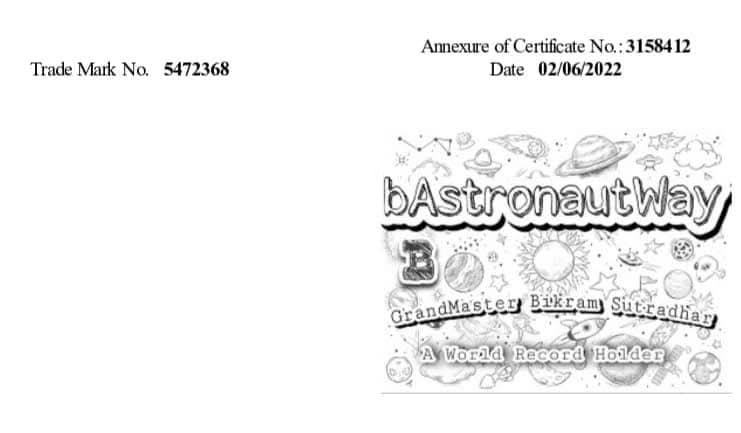
bAstronautWay : A Government-Approved Trademark Brand
SirBikramSutradhar on YouTube
📘 INTEGRATION – 200 QUESTIONS Easy to Pr Click here