
📘 Becoming an Astronaut in India (ISRO) – A Complete Guide After Class 12
📘 Becoming an Astronaut in India (ISRO) – A Complete Guide After Class 12
📘 Becoming an Astronaut in India (ISRO) – A Complete Guide After Class 12
✍️ Author: GrandMaster Bikram Sutradhar
🏛️ Institute: bAstronautWay
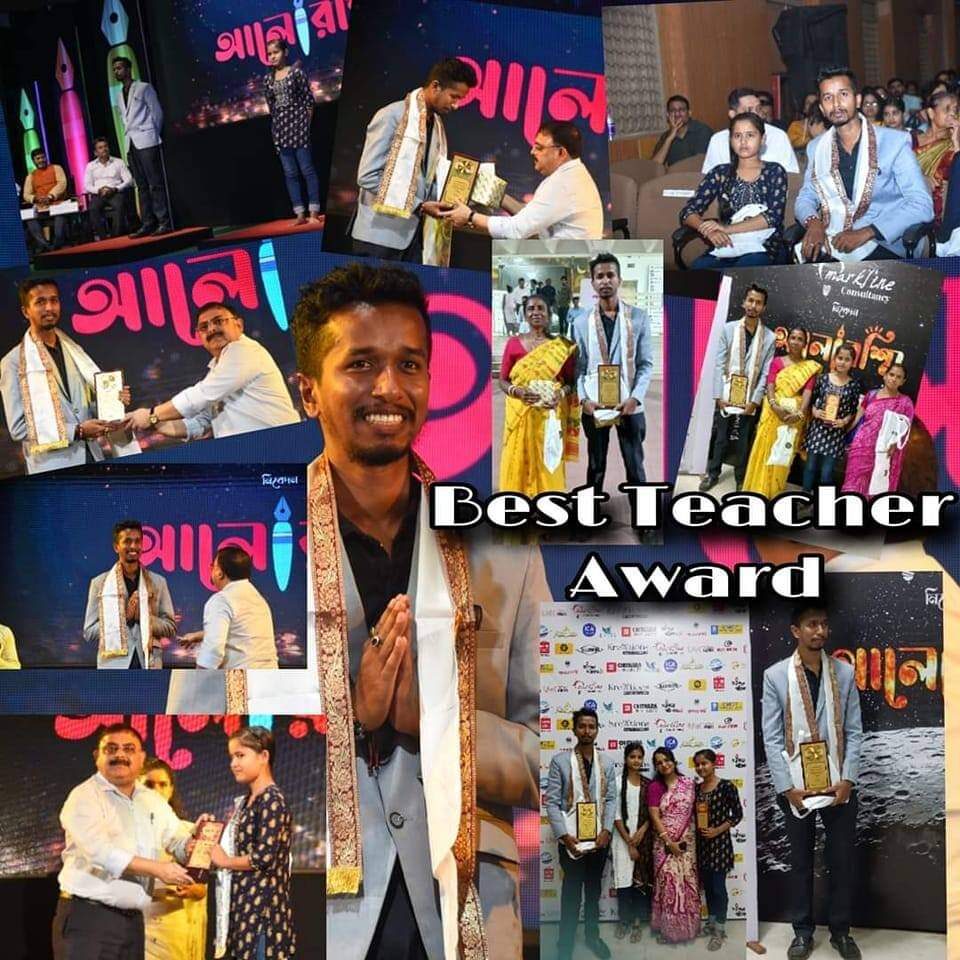
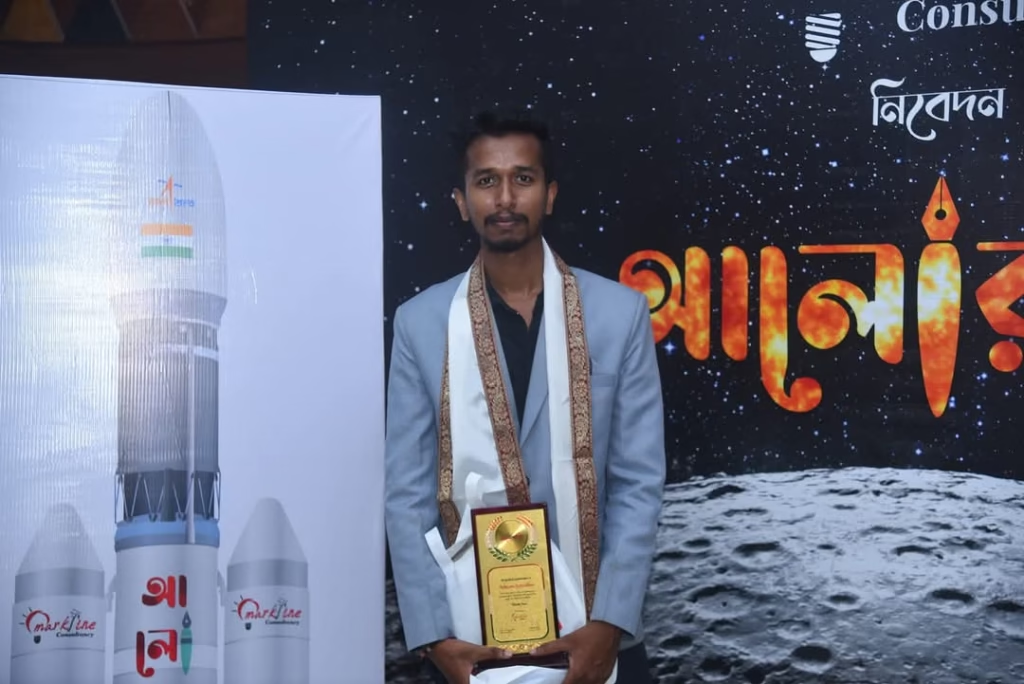
🚀 5-Time World Record Holder | Best Teacher Awardee 2023
🌠 Dreaming of Space? Here’s How to Become an Astronaut with ISRO
With India’s Gaganyaan mission, ISRO is preparing to send Indian astronauts (Vyomanauts) into space. Unlike the past (e.g., Rakesh Sharma in 1984), the future astronauts may come from engineering, science, or research backgrounds—not just the Air Force. If you’re a Class 12 student aiming for space, this guide is your step-by-step map.
🧑🚀 Step 1: Choose the Right Stream After Class 12
- Choose Science Stream (PCM) – Physics, Chemistry, Maths are essential.
- Score high in Class 12 Boards (minimum 75% often needed for top exams).
- Prepare for Competitive Exams –
- JEE Main + Advanced (for IITs and IIST)
- IIST Admission – IIST (Indian Institute of Space Science and Technology) takes students based on JEE-Advanced rank.
📝 Example: A student from Kerala with JEE rank under 10,000 entered IIST Aerospace Engineering.
🎓 Step 2: Best Degrees to Become an Astronaut
✅ Top Undergraduate Degrees:
- B.Tech in Aerospace, Mechanical, Electronics, Computer Science
- Dual degree: Engineering Physics + M.Sc/M.Tech
- B.Sc in Physics/Astronomy followed by M.Sc/M.Tech
✅ Postgraduate Degrees (Optional but Strongly Recommended):
- M.Tech or Ph.D. in Aerospace, Astrophysics, Satellite Tech, Propulsion
- Research-oriented degrees make you stand out for astronaut roles
📌 Note: ISRO values candidates with strong technical degrees and research experience.
🏫 Step 3: Top Institutes to Target
- IIST (Thiruvananthapuram) – ISRO’s own institute
- Courses: Aerospace, Avionics, Dual Degree
- Admission: JEE-Advanced
- High performers placed directly in ISRO
- IITs (Bombay, Madras, Kanpur, Kharagpur) – Strong aerospace programs
- IISc Bengaluru, IISERs – Pure science + space research paths
- BITS Pilani, VIT, Manipal – Top private institutes with space-related programs
- NDA/Air Force Academy – For flying/defence route to space
🚀 Step 4: Join ISRO as a Scientist/Engineer
🛠️ ISRO Recruitment Process:
- Take GATE exam (in Aerospace, Mech, ECE, CS, Physics, etc.)
- Apply for Scientist/Engineer ‘SC’ posts on ISRO’s website
- IIST grads with top CGPA (7.5+) get direct ISRO placement
Once in ISRO, you may work on:
✅ Launch vehicles (rockets), satellites
✅ Life-support systems for astronauts
✅ Space research and mission planning
🔭 This real-world work builds technical expertise needed for astronaut roles.
🧬 Step 5: Astronaut Selection Criteria (ISRO)
ISRO is building its own Human Space Flight Centre (HSFC). Gaganyaan astronauts are selected through a rigorous process:
📌 Key Requirements:
- STEM Degree (B.Tech/B.Sc + M.Sc/M.Tech preferred)
- Top physical and medical fitness
- Excellent mental strength and teamwork
- No chronic illnesses, good eyesight, fit BMI
🧠 Psychological tests, neuro-assessments, and interviews are included.
✈️ Currently, ISRO has chosen 4 IAF test pilots for Gaganyaan, but future astronauts will be engineers and scientists too.
🏋️ Step 6: Astronaut Training Process
Once selected, training includes:
✅ Classroom Study – Spacecraft systems, mission planning
✅ Simulators & Flight Suits – Operating spacecraft, docking
✅ Fitness & Centrifuge Training – G-force tolerance, zero gravity
✅ Medical & Survival Training – Emergency survival on land and sea
✅ Yoga & Meditation – Focus, discipline, stress management
🌍 Initial batches trained in Russia, but now India has its own training base in Karnataka.
📚 Step 7: Subjects & Skills to Focus On (From Class 12)
🎯 Academic Skills:
- Physics (Mechanics, Electromagnetism)
- Mathematics (Calculus, Algebra, Trigonometry)
- Computer Science & Electronics
- Aerodynamics, Satellite Basics
💪 Fitness & Soft Skills:
- Daily sports or gym (run, swim, cycle)
- Teamwork, leadership, problem-solving
- Projects on astronomy, robotics, model rocketry
🧑🎓 Step 8: Timeline to Space (Your Career Plan)
| Age | Milestone |
| 17–18 | Pass Class 12 (PCM) with high marks |
| 18–22 | B.Tech/B.Sc from IIST, IIT, or top college |
| 22–25 | GATE + Join ISRO as Engineer/Scientist |
| 25–30 | Gain 3–5 yrs experience, M.Tech/Ph.D (optional) |
| 30+ | Apply for Astronaut Program |
💬 Becoming an astronaut takes 8–12 years of dedication.
📢 Final Message –
“Becoming an astronaut is not a one-time goal—it’s a journey of science, service, and strength. Prepare early, work hard, stay fit, and stay curious. One day, India’s tricolor may soar in space with you aboard!”
🛰️ Resources for You:
- www.iist.ac.in
- www.isro.gov.in
- (Learning platform by Sir Bikram)
📱 Follow: #bAstronautBySirBikramsutradhar | #GaganyaanMission2030
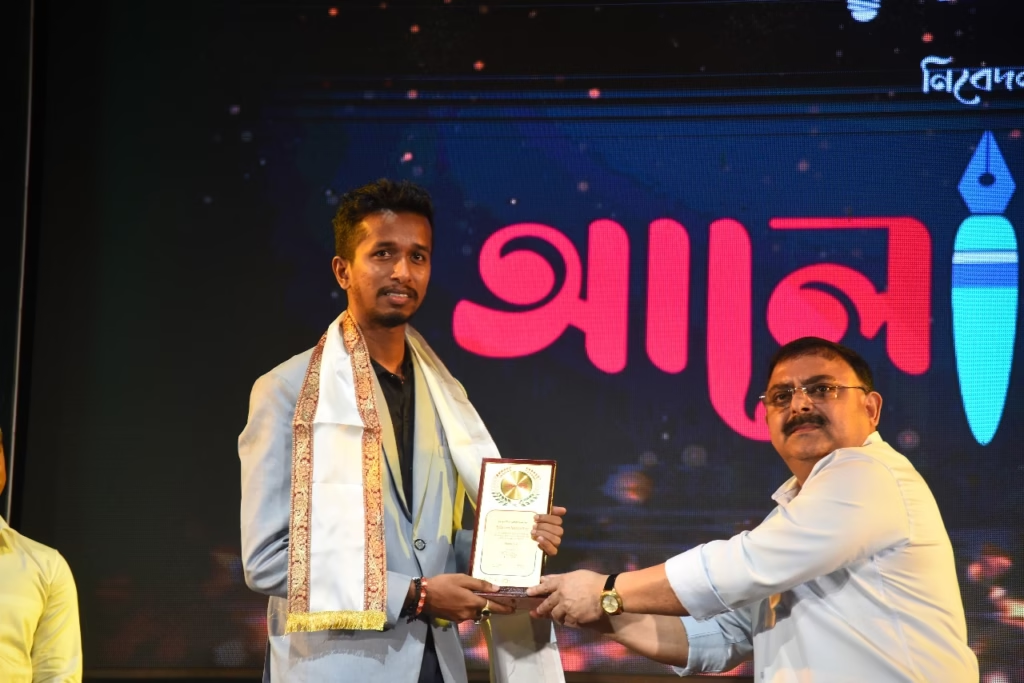

Written By
Full Stack Developer and 5-Time World Record Holder, Grandmaster Bikram Sutradhar
bAstronautWay : A Government-Approved Trademark Brand
SirBikramSutradhar on YouTube

SirBikramSutradhar is also a Government-Approved Trademark Brand.
Written By
Full Stack Developer and 5-Time World Record Holder, Grandmaster Bikram Sutradhar
bAstronautWay
SirBikramSutradhar on YouTube
More Story click the link
ICSE CLASS 10 ICSE CLASS 10 BIOLOGY BASTRONAUTWAY SirBikramSutradhar Bikram Sutradhar GrandMaster Bikram Sutradhar selina biology solutions ICSE Biology Selina Solution
📚 Class 9 Science – Complete Table of Contents (विषय-सूची)
CBSE | NCERT Curriculum | Bilingual (English + Hindi)
By Grandmaster Bikram Sutradhar | SirBikramSutradhar | BASTRONAUTWAY
🔬 PHYSICS (भौतिक विज्ञान)
| 🔢 | Chapter Title (English) | अध्याय का नाम (हिंदी) | Page No. |
| 1️⃣ | Motion | गति | |
| 2️⃣ | Force and Laws of Motion | बल तथा गति के नियम | |
| 3️⃣ | Gravitation | गुरुत्वाकर्षण | |
| 4️⃣ | Work and Energy | कार्य तथा ऊर्जा | |
| 5️⃣ | Sound | ध्वनि |
🧪 CHEMISTRY (रसायन विज्ञान)
| 🔢 | Chapter Title (English) | अध्याय का नाम (हिंदी) | Page No. |
| 1️⃣ | Matter in Our Surroundings | हमारे आस-पास के पदार्थ | |
| 2️⃣ | Is Matter Around Us Pure? | क्या हमारे आस-पास के पदार्थ शुद्ध हैं? | |
| 3️⃣ | Atoms and Molecules | परमाणु एवं अणु | |
| 4️⃣ | Structure of the Atom | परमाणु की संरचना |
🧬 BIOLOGY (जीव विज्ञान)
| 🔢 | Chapter Title (English) | अध्याय का नाम (हिंदी) | Page No. |
| 1️⃣ | The Fundamental Unit of Life | जीवन की मौलिक इकाई | |
| 2️⃣ | Tissues | ऊतक | |
| 3️⃣ | Improvement in Food Resources | धनों में सुधार |
📘 ADDITIONAL SECTIONS (अतिरिक्त अनुभाग)
| 📖 Section | Title (English + Hindi) |
| 🔹 | Glossary / पारिभाषिक शब्दावली |
| 🔹 | Answer Keys / उत्तरमाला |
| 🔹 | Summary / सारांश |
| 🔹 | Important Diagrams / महत्वपूर्ण चित्र |
| 🔹 | NCERT Exercises / एनसीईआरटी अभ्यास |
| 🔹 | Sample Papers & MCQs / मॉडल पेपर व वस्तुनिष्ठ प्रश्न |
✅ All content follows the official NCERT Class 9 Science textbook structure. Each chapter will include explanations, bilingual notes, definitions, diagrams, MCQs, FAQs, and practice exercises under the BASTRONAUTWAY learning system.
class 10 Maths ncert solution.
CBSE Class 10 Mathematics (2025) NCERT Syllabus:
CBSE Class 10 Mathematics NCERT Syllabus (2025) – Chapter-Wise List
CBSE Class 10 Mathematics NCERT Syllabus (2025) – Chapter-Wise List
chapter 4. Quadratic Equations
chapter 5. Arithmetic Progressions
chapter 6. Triangles
chapter 7. Coordinate Geometry
chapter 8. Introduction to Trigonometry
chapter 9. Some Applications of Trigonometry
chapter 11. Areas Related to Circles
chapter 12. Surface Areas and Volumes
CBSE Class 10 Science (2025) NCERT Syllabus:
CBSE Class 10 Science NCERT Syllabus (2025) – Chapter-Wise List
CBSE Class 10 Science NCERT Syllabus (2025) – Chapter-Wise List
Chapter 1 Chemical Reactions and Equations
Chapter 2 Acids, Bases and Salts
Chapter 3 Metals and Non-metals
Chapter 4 Carbon and its Compounds
Chapter 5 Life Processes
Chapter 6 Control and Coordination
Chapter 7 How do Organisms Reproduce?
Chapter 8 Heredity
Chapter 9 Light – Reflection and Refraction
Chapter 10 The Human Eye and the Colourful World
Chapter 11 Electricity
Chapter 12 Magnetic Effects of Electric Current
Chapter 13 Our Environment
📖 Chapter 12 – Organic Chemistry (Selina Textbook)
Table of Contents:
- 12A. Organic Compounds
- 12B. Hydrocarbons: Alkanes
- 12C. Hydrocarbons: Alkenes
- 12D. Hydrocarbons: Alkynes
- 12E. Alcohols
- 12F. Carboxylic Acids
- Exercise 12 MISCELLANEOUS
- Glossary
- Model Question Paper –
📌 Exercise 12 MISCELLANEOUS – Focus Areas:
- 🧬 Consolidated practice from the entire Organic Chemistry chapter
- 🧪 Application-based questions covering alkanes, alkenes, alkynes, alcohols, and carboxylic acids
- 🧾 Writing structural formulas and chemical equations
- 💡 Distinguishing reactions, isomer identification, and conversions
- 📘 Full-syllabus revision to boost conceptual clarity and board exam readiness
Each question in this section is designed to:
- ✅ Strengthen cross-topic understanding
- 📝 Prepare students for application-based and reasoning-based questions
- 🧠 Improve problem-solving speed and exam performance
class 5
📚 Class 9 Science – Complete Table of Contents (विषय-सूची)
CBSE | NCERT Curriculum | Bilingual (English + Hindi)
By Grandmaster Bikram Sutradhar | SirBikramSutradhar | BASTRONAUTWAY
🔬 PHYSICS (भौतिक विज्ञान)
| 🔢 | Chapter Title (English) | अध्याय का नाम (हिंदी) | Page No. |
| 1️⃣ | Motion | गति | |
| 2️⃣ | Force and Laws of Motion | बल तथा गति के नियम | |
| 3️⃣ | Gravitation | गुरुत्वाकर्षण | |
| 4️⃣ | Work and Energy | कार्य तथा ऊर्जा | |
| 5️⃣ | Sound | ध्वनि |
🧪 CHEMISTRY (रसायन विज्ञान)
| 🔢 | Chapter Title (English) | अध्याय का नाम (हिंदी) | Page No. |
| 1️⃣ | Matter in Our Surroundings | हमारे आस-पास के पदार्थ | |
| 2️⃣ | Is Matter Around Us Pure? | क्या हमारे आस-पास के पदार्थ शुद्ध हैं? | |
| 3️⃣ | Atoms and Molecules | परमाणु एवं अणु | |
| 4️⃣ | Structure of the Atom | परमाणु की संरचना |
🧬 BIOLOGY (जीव विज्ञान)
| 🔢 | Chapter Title (English) | अध्याय का नाम (हिंदी) | Page No. |
| 1️⃣ | The Fundamental Unit of Life | जीवन की मौलिक इकाई | |
| 2️⃣ | Tissues | ऊतक | |
| 3️⃣ | Improvement in Food Resources | धनों में सुधार |
📘 ADDITIONAL SECTIONS (अतिरिक्त अनुभाग)
| 📖 Section | Title (English + Hindi) |
| 🔹 | Glossary / पारिभाषिक शब्दावली |
| 🔹 | Answer Keys / उत्तरमाला |
| 🔹 | Summary / सारांश |
| 🔹 | Important Diagrams / महत्वपूर्ण चित्र |
| 🔹 | NCERT Exercises / एनसीईआरटी अभ्यास |
| 🔹 | Sample Papers & MCQs / मॉडल पेपर व वस्तुनिष्ठ प्रश्न |
✅ All content follows the official NCERT Class 9 Science textbook structure. Each chapter will include explanations, bilingual notes, definitions, diagrams, MCQs, FAQs, and practice exercises under the BASTRONAUTWAY learning system.
class 10 Maths ncert solution.
NCERT Solutions
CBSE Class 10 Mathematics (2025) NCERT Syllabus:
CBSE Class 10 Mathematics NCERT Syllabus (2025) – Chapter-Wise List
CBSE Class 10 Mathematics NCERT Syllabus (2025) – Chapter-Wise List
chapter 4. Quadratic Equations
chapter 5. Arithmetic Progressions
chapter 6. Triangles
chapter 7. Coordinate Geometry
chapter 8. Introduction to Trigonometry
chapter 9. Some Applications of Trigonometry
chapter 11. Areas Related to Circles
chapter 12. Surface Areas and Volumes
NCERT Solutions
CBSE Class 10 Mathematics (2025) NCERT Syllabus:
CBSE Class 10 Mathematics NCERT Syllabus (2025) – Chapter-Wise List
CBSE Class 10 Mathematics NCERT Syllabus (2025) – Chapter-Wise List
chapter 4. Quadratic Equations
chapter 5. Arithmetic Progressions
chapter 6. Triangles
chapter 7. Coordinate Geometry
chapter 8. Introduction to Trigonometry
chapter 9. Some Applications of Trigonometry
chapter 10. Circles
chapter 11. Areas Related to Circles